iPhone Air Launch Featuring A19 Pro Chip Power
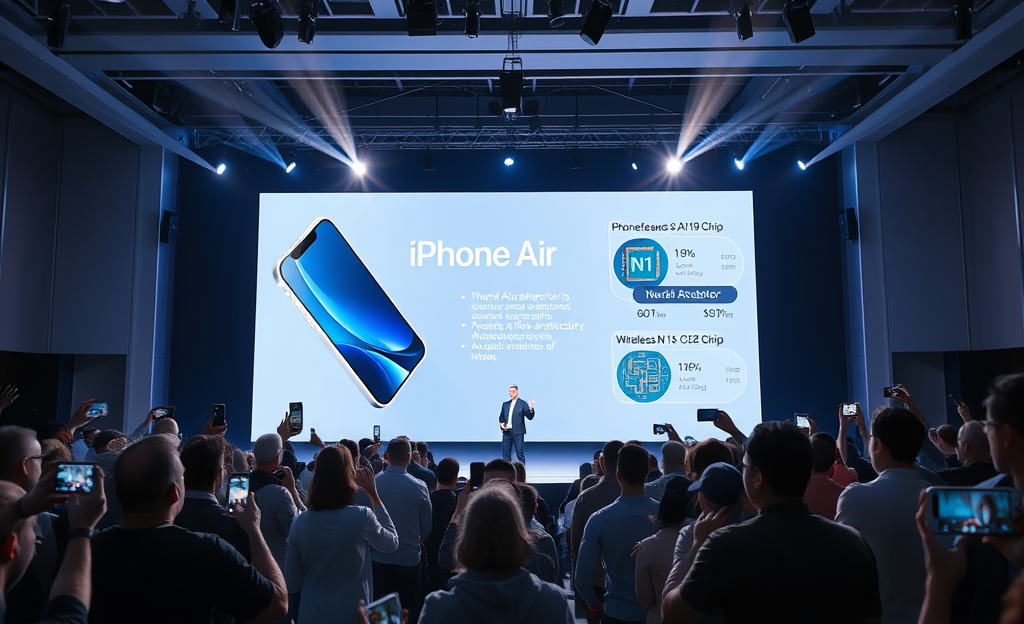
The iPhone Air has taken the tech world by storm with its remarkable launch, showcasing the advanced A19 Pro chip that redefines mobile computing.
This article delves into the innovative features of the iPhone Air, including its unparalleled GPU performance boosted by neural accelerators and the introduction of the groundbreaking wireless N1 chip and C1X modem.
We will also explore Apple’s strategic investments in AI and chip manufacturing, aimed at enhancing device efficiency while reducing reliance on external suppliers.
Join us as we unpack how the iPhone Air sets new standards in the smartphone industry.
iPhone Air Debut and the A19 Pro Revolution
The debut of the iPhone Air marks a ground-breaking performance shift in mobile technology, offering users an unprecedented experience powered by its heart, the A19 Pro chip.
Epitomizing the pinnacle of innovation, this chip is meticulously crafted to redefine expectations.
It integrates neural accelerators within every GPU core, a technical marvel that enhances computational abilities, transforming how mobile devices handle complex tasks.
What makes this innovation truly revolutionary is its seamless ability to conduct AI processing on-device, reshaping the future of mobile computing.
With Apple now fully controlling core functionalities thanks to the introduction of the wireless N1 chip and C1X modem, they have claimed dominance over essential chip operations, thus setting new benchmarks in speed and efficiency.
As described in Introducing iPhone Air, these advancements not only boost device performance to rival that of a MacBook Pro but also pave the way for more sustainable energy use and reduced dependency on suppliers.
The iPhone Air, therefore, isn’t just another product launch; it’s a dramatic leap toward an integrated future of cutting-edge mobile technology.
Innovative Architecture and Embedded Neural Accelerators
The A19 Pro chip elevates Apple’s architecture with its groundbreaking pipeline redesign and sophisticated cache hierarchy.
Apple ingeniously incorporates neural accelerators into each GPU core, setting new performance benchmarks.
The transistor count within the A19 Pro is remarkably high, driving efficiency that mirrors MacBook Pro levels in an iPhone.
This synergy between the neural accelerators and GPU cores enhances computational prowess, effectively enabling a myriad of complex AI workloads.
According to this resource, AI processing capabilities witness a stark enhancement, with increases of up to four times more AI computations.
The architecture’s efficiency unlocks substantial power savings, further emphasized by the A19 Pro’s cache system advancements.
Such integration showcases Apple’s relentless innovation trajectory, reflecting a robust, forward-facing chip design.
This strategic embedment not only bolsters performance but also ensures optimized energy consumption, reinforcing Apple’s lead in mobile technology evolution.
Next-Gen Connectivity: N1 Wireless Chip and C1X Modem Integration
The integration of Apple’s N1 wireless chip and the C1X modem plays a crucial role in optimizing the iPhone Air’s connectivity capabilities.
The N1 chip, which supports Wi-Fi 7, Bluetooth 6, and Thread, empowers these devices with enhanced connectivity options.
By embedding the state-of-the-art A19 Pro chip architecture, Apple ensures that these components work in harmony to process data efficiently, offloading computational burdens from the SoC.
This, in effect, leads to reduced latency and an overall smoother user experience, perfect for applications demanding high-speed data transmission.
Moreover, the C1X modem introduces an additional layer of sophistication in managing cellular and network protocols.
With the ability to offer up to twice the speed of Qualcomm modems and promising a 30% decrease in power consumption, the modem supports spectrum agility for seamless connectivity in varying environments.
These features collectively allow the iPhone Air to maintain stable performance, even in demanding network conditions.
As Apple continues its investment in AI and on-device processing, this internal coordination between the N1 and C1X becomes pivotal, showcasing how hardware innovation can amplify the mobile experience.
C1 Modem Performance and Power Efficiency
Apple’s move into proprietary modems with the C1 has sparked notable interest, specifically due to its capacity for better performance and efficiency.
By leveraging its 2× speed over Qualcomm modems in certain benchmarks, users can experience faster data transfer rates, enhancing their internet browsing and download experiences.
This advancement is complemented by the modem’s ability to cut power consumption by 30 percent, ensuring that battery life is significantly preserved during high-data activities.
Reports from Ookla have pointed out situations where the C1 modem excels over Qualcomm’s Snapdragon, particularly under varying network conditions.
This innovation means fewer charging interruptions for users, making long travel days more manageable.
- 2× faster speeds enhance data transmission.
- 30% lower power draw boosts battery life.
- Superior performance in less ideal network conditions.
- Less dependency on Qualcomm chips.
- Significant innovation for on-device user experience.
On-Device AI and Developer Environment Optimization
Apple’s significant investment in AI toolchains and on-device processing is revolutionizing the developer ecosystem.
With a keen focus on boosting device-level intelligence, Apple enables developers to create more responsive and personalized apps.
This leap forward minimizes reliance on cloud processing, enhancing both speed and privacy—a core value in Apple’s AI strategy.
The A19 Pro chip’s advanced architecture incorporates neural accelerators, which play a pivotal role in powering these innovative on-device capabilities.
As Apple’s AI vision crystallizes, it emphasizes, “
This is the decade of on-device intelligence
,” signaling a paradigm shift.
Developers benefit tremendously, as they can build applications that make real-time decisions locally on devices.
This move not only optimizes performance but also aligns with Apple’s privacy-first principles.
Ultimately, these strategic enhancements form an enduring foundation for developers eager to harness cutting-edge AI technology within Apple’s vibrant ecosystem.
A19 Pro Versus MacBook Pro: Performance Parity
Apple’s latest A19 Pro chip in the iPhone Air is revolutionizing the way we perceive mobile computing power.
Benchmark comparisons reveal that the A19 Pro nearly matches the 14-inch MacBook Pro, setting a new standard.
This is evident in CPU and GPU performances, bringing mobile devices and laptops closer in terms of efficiency and computing capabilities.
Below is a comparison of headline CPU and GPU metrics:
| Device | CPU Performance | GPU Performance |
|---|---|---|
| A19 Pro | 97% | 93% |
| 14-inch MacBook Pro | 100% | 100% |
This underlines a big milestone as mobile computing now provides almost MacBook-level power, shifting user expectations toward more capable handheld devices.
Scaling US Chip Manufacturing with a $600 B Investment
Apple’s ambitious plan to inject $600 billion into US chip fabrication marks a significant move towards reinforcing its supply chain and counteracting tariff implications.
By focusing on domestic production, Apple aims to mitigate the external pressures and enhance control over its manufacturing processes.
This investment highlights a strategic shift towards achieving supply chain independence, an approach necessitated by recent challenges in international logistics.
Collaborating with key partners such as TSMC and Texas Instruments [visit Apple’s Newsroom for more details](https://www.apple.com/newsroom/2025/08/apple-increases-us-commitment-to-600-billion-usd-announces-ambitious-program/), Apple seeks to build a robust infrastructure that reduces dependency on overseas suppliers.
In unifying its efforts within the United States, Apple not only addresses tariff concerns but also paves the way for more agile and resilient operations.
This integration of chip manufacturing domestically ensures more efficient responses to market demands and aligns with environmental sustainability goals given reduced shipping distances and emissions.
Furthermore, this move empowers Apple to maintain stringent quality standards, crucial for products like the new iPhone Air, which utilizes the cutting-edge A19 Pro chip.
- Strengthen control over the supply chain to enhance reliability and efficiency
- Create jobs and boost economic growth within the US, stimulating technological advancements
- Reduce operational costs and environmental impact by minimizing overseas logistics
- Foster innovation in chip technology with enhanced on-device AI capabilities
Strategic Shift to Proprietary Silicon
Apple’s strategic shift towards proprietary silicon marks a pivotal moment in its history The A19 Pro chip exemplifies Apple’s commitment to reducing supplier reliance by controlling both hardware and software development This approach not only creates significant barriers for competitors but also enhances product uniqueness With the C1 modem promising double the speed and less power consumption, Apple outpaces existing Qualcomm offerings Furthermore, by integrating the wireless N1 chip and C1X modem, Apple brings critical functionalities in-house This strategy echoes its vast investment commitment to the U S with a targeted $600 billion investment As noted in Supply Chain Innovation, Apple improves its sustainable practices by leveraging these technology advancements The focus on energy efficiency ensures that devices consume less power while maintaining high performance This cohesive advancement in proprietary silicon directly translates to diminished supplier reliance and enhanced energy efficiency in Apple’s offerings
The iPhone Air represents a significant leap forward in smartphone technology, combining cutting-edge hardware with a commitment to sustainability and efficiency.
Apple’s focus on proprietary silicon and AI capabilities ensures that this device is not just a phone, but a powerful tool for the future.



0 Comments