Global Economic Growth Evolution Over Centuries
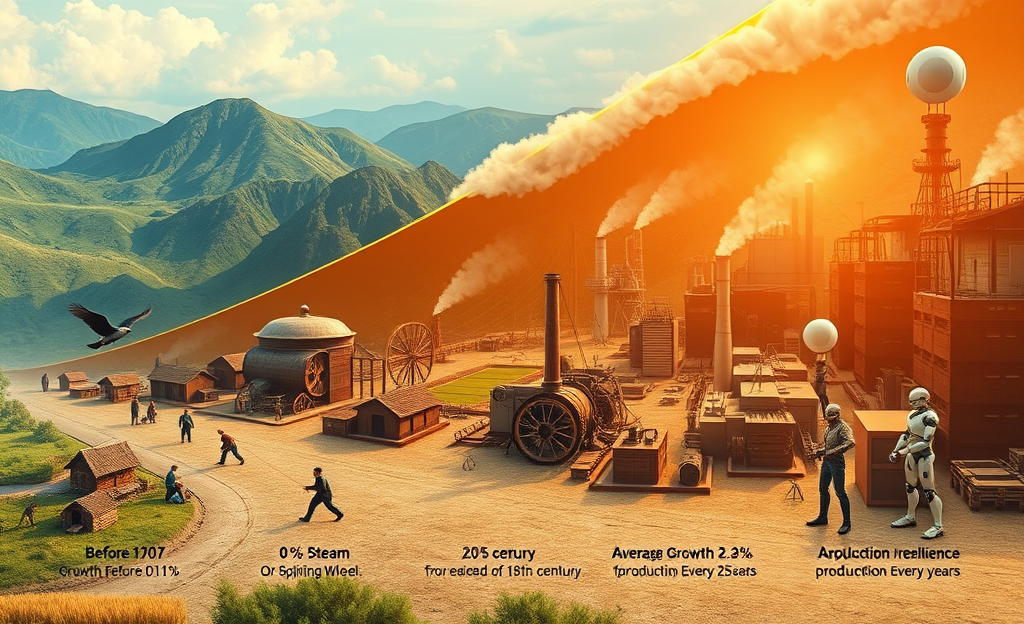
Economic Growth has evolved significantly over the centuries, shaping the world we live in today.
This article explores the historical trends of economic growth, starting from its modest beginnings until 1700, through the technological innovations that spurred acceleration between 1700 and 1820, and the remarkable economic boom of the 19th century.
We will also examine the unprecedented growth of the 20th century, where production doubled every 25 years, establishing continuous growth as a norm.
Finally, we will discuss the transformative potential of artificial intelligence and its implications for global markets.
Evolution of Global Economic Growth
The historical evolution of global economic growth reveals significant shifts in productivity and technological advancements over centuries.
Before 1700, the average growth rate was a modest 0.1% per year, reflecting the agrarian-based economies and limited industrial activities of the time.
Between 1700 and 1820, however, the introduction of early industrial technologies such as the spinning wheel and steam engine catalyzed a rise in growth to 0.5% per year, setting the stage for even more remarkable advancements in the centuries that followed.
Economic Expansion in the 19th Century
The 19th century marked a significant acceleration in global economic growth, achieving an average rate of 1.9% by 1900. This surge was fueled largely by industrialization, which transformed economies from agrarian to industrial powerhouses.
The driving force behind this growth was the mechanization of manufacturing processes.
Factories emerged as the new centers of production, replacing traditional artisan crafts with machine-driven efficiency.
In particular, the textile industry saw tremendous advancements with inventions like the spinning jenny and power loom, rapidly increasing production capacity and efficiency.
Furthermore, the expansion of the infrastructure network was paramount to industrial success during this period.
Railways played a critical role in this transformation, facilitating the swift and cost-effective movement of goods and people.
In regions like the United States, where railroads expanded dramatically, they opened new economic opportunities and catalyzed the development of internal markets.
According to the Library of Congress, railroads significantly lowered transportation costs, driving down shipping rates by 80%, making shipping by rail highly cost-competitive compared to traditional methods like river transport.
This period also saw a massive increase in urbanization, as populations flocked to cities where industries were flourishing.
Cities became bustling hubs of economic activity, contributing to the era’s robust economic growth.
As manufacturing grew, it not only increased production output but also generated vast employment opportunities, drawing millions into the workforce.
The synergistic effect of industrialization, backed by advancements in transportation and mechanized manufacturing, fundamentally altered the economic landscape, paving the way for the sustained growth patterns observed within the century.
20th Century Growth and Its Economic Implications
The sustained 2.8% average growth of the 20th century altered the global economic landscape.
This pace meant that production doubled every quarter-century, bringing unprecedented changes to industries and societies alike.
Technology, access to capital, and improvements in labor productivity, as highlighted in sources such as The Economist, played pivotal roles in facilitating this growth.
Nations experienced a boost in infrastructure, innovation, and living standards—each interconnected and feeding into the next stage of growth.
This remarkable output growth adjusted expectations for economic success globally.
Societies became accustomed to consistent improvements in quality of life and technological advancements.
This environment shaped modern economic policies, forcing nations to adopt strategies that promote sustained growth and innovation.
The post-World War II international order established by thriving economies further cemented the importance of maintaining such growth rates, proving essential for robust global economic health and stability.
Continued studies, like those referenced by NBER, emphasize the importance of these historical changes in framing current economic challenges and opportunities.
The Future Impact of Artificial Intelligence on Markets
The current race in AI development is set to dramatically reshape various markets, impacting goods, services, and financial assets.
AI’s potential to significantly increase productivity could lead to the emergence of new industries and the transformation of existing ones.
According to the International Monetary Fund (IMF), almost 40% of jobs globally could be affected by AI, suggesting both opportunities and challenges.
Companies competing in this technological arms race will drive innovation, streamline operations, and potentially edge out slower adopters, leading to a period of Relevant text where markets must adapt swiftly.
The implications for economic growth could be profound.
The introduction of AI technologies into traditional sectors promises efficiencies and enhanced decision-making capabilities beyond current comprehension.
Increasingly, AI is positioned as a catalyst for radical market changes, creating sectors that prioritize adaptability and resilience.
Industry leaders, such as those highlighted in the McKinsey Report on AI’s economic impact, predict numerous potential effects which may include:
- Disruption of labor markets
- Emergence of AI-centric industries
- Increased global GDP growth
Comparative Growth Metrics Overview
| Period | Average Growth Rate |
|---|---|
| Pre-1700 | 0.1% |
| 1700-1820 | 0.5% |
| 19th Century | 1.9% |
| 20th Century | 2.8% |
The evolution of global economic growth reveals a trend of significant acceleration over the centuries, with technology playing a crucial role.
Before 1700, growth was limited at an average of 0.1% annually.
However, innovations like the spinning wheel and steam engine drove growth to 0.5% from 1700 to 1820. Further advancements in the 19th century, alongside the Industrial Revolution, boosted growth to 1.9%.
The 20th century saw average growth rates soar to 2.8%, a remarkable change supported by technological progress and globalization, which allowed production to double every 25 years.
This pattern underscores the transformative impact of technology on global economic dynamics as discussed in the Global GDP overview, establishing economic growth as the norm and accelerating market trends.
Economic Growth continues to be a driving force in shaping markets, with new technologies like AI poised to redefine our economic landscape.
Understanding these historical trends is essential for navigating future challenges and opportunities.



0 Comments