US Economy Surges Past Forecast Amid Tariff Impact
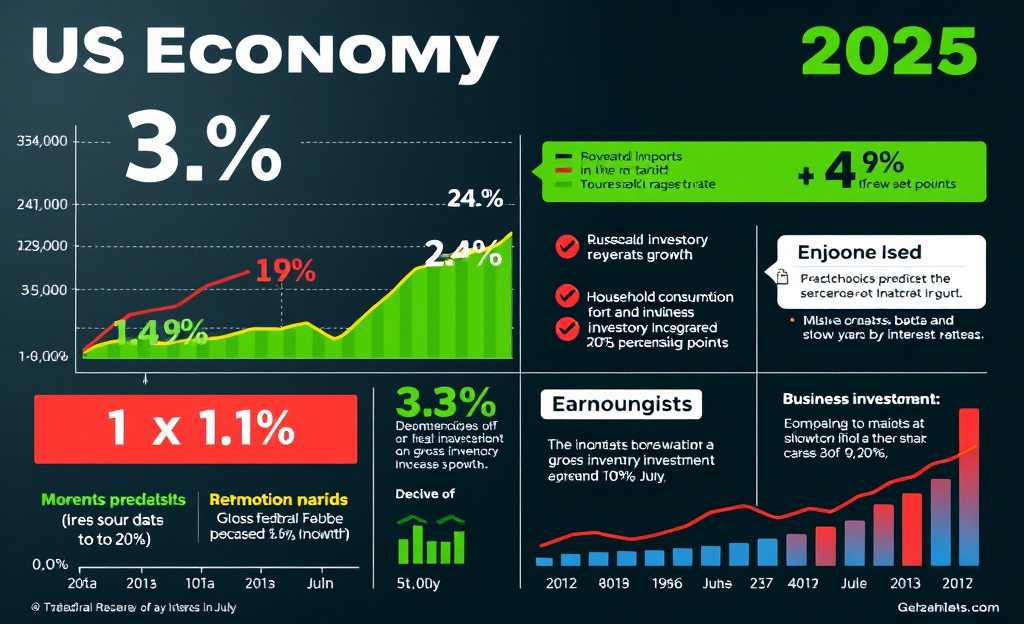
Economic Growth has been a focal point in recent discussions regarding the US economy, especially after the surprising 3% growth rate recorded in the second quarter of 2025. This figure not only exceeded the initial forecast of 2.4%, but also highlights the complex interplay between consumer behavior and governmental policies such as tariffs.
In this article, we will delve deeper into the factors contributing to this growth, including household consumption and business investment, while also examining the potential challenges posed by rising inflation and a slowing growth forecast in the coming months.
Overview of Q2 2025 US Economic Growth
The US economy showed a 3% adjusted annual growth in the second quarter of 2025, surpassing the anticipated 2.4% increase and highlighting a surprising economic recovery.
Part of this growth arose not merely from underlying economic resilience but rather due to trade distortions.
According to reports from CEPR’s analysis, these distortions were influenced by a marked decline in imports, driven by preemptive moves to counteract the effect of upcoming tariffs.
This reduction in imports temporarily boosted GDP figures yet conceals potential challenges that may surface in subsequent quarters.
While household consumption and business investments contributed modestly to the growth, these components may be hampered by the consequences of rising tariff-induced costs, casting doubts on sustained performance, as detailed by experts from Wall Street Journal’s insights.
Trade Distortions from Tariffs
The recent economic environment experienced anticipatory purchases by firms trying to circumvent the looming tariff hike, causing a import decline that distorted GDP figures.
Corporations accelerated their buying activities before these tariffs took effect, creating a temporary spike in import activities that, once subsided, skewed the economic growth measurements.
Meanwhile, the average tariff rate surged to around 20%, reshaping trade flows and leading to potential inflation risks as the costs of imported goods rose.
This strategic shift in buying patterns, detailed on
Morgan Global Research on US Tariffs”>J.P. Morgan Global Research on US Tariffs
The tariffs designed to bolster domestic industries have inadvertently dampened consumer purchasing power, highlighting a complex dynamic within international trade relations.
- Firms accelerate purchases pre-tariff spike.
- Import decline follows a temporary glut.
- Tariff rates elevated to 20%.
- Potential inflation risks from increased trade costs.
- Impact on consumer purchasing power and business operations.
Domestic Demand: Consumption and Investment
In Q2 2025, the US economy experienced a solid rise in household consumption by 1.4 percent, signaling a robust domestic demand amid trade disturbances caused by growing tariff rates.
This positive trend reflects the resilience of American consumers in the face of potential price hikes due to tariffs, a fact supported by various analyses such as from CNBC’s GDP Analysis.
Similarly, business investment saw an uptick of 1.9 percent, suggesting that despite the economic headwinds, businesses continue to invest in growth and development opportunities.
These developments underscore steady domestic demand, an essential driver for economic stability during times of international trade challenges.
As inflationary pressures loom, it is vital for both consumers and businesses to adapt and strategize effectively within this evolving economic landscape.
| Category | Q2 2025 Growth |
|---|---|
| Household Consumption | 1.4% |
| Business Investment | 1.9% |
Drag from Inventory Adjustment
The US economy witnessed a robust 3% growth rate in Q2 2025, however, it concealed an underlying issue—the substantial drag from inventories.
The significant negative impact of gross inventory investment became evident as it detracted 3.2 percentage points from overall GDP growth.
This masked the inherent momentum in final demand and painted an inaccurate picture of economic strength.
While factors like a remarkable rise in household consumption and business investment bolstered growth, the inventory adjustment remained a formidable challenge.
This phenomenon, as noted by Yahoo Finance Growth Insights, underscores the complex dynamics influencing economic assessments.
Such fluctuations in inventory levels can distort economic interpretation, hence emphasizing the necessity to delve deeper into these numbers to grasp a clearer economic health snapshot.
Forward-Looking Outlook and Policy Stance
Economists are anticipating that the US economic growth will decelerate to below 1% growth in the upcoming quarters, largely driven by the effects of tariffs raising inflation.
This scenario arises as these tariffs are expected to diminish consumer purchasing power, resulting in a more sluggish economic activity.
Despite this, the Federal Reserve has decided to keep interest rates unchanged, as noted in a recent Federal Reserve’s Monetary Policy Statement.
The combination of rising inflation and stagnant rates is likely to further pressure economic performance, raising concerns about prolonged sluggish growth.
- Increased costs due to tariffs raising inflation on imported goods reduce consumer spending
- Businesses face uncertainty and holding back on new investments
- Strong dollar affecting export competitiveness
Labor Market Snapshot for July 2025
The Department of Labor’s forecast for July 2025 anticipates the addition of 109,000 jobs, marking a slowdown from the more robust figures seen in previous months.
This deceleration in job growth illuminates a softer hiring trend, which becomes evident when compared to the June increase of 147,000 jobs, a detail confirmed by the Bureau of Labor Statistics.
Economists suggest that this moderation aligns with broader economic predictions, where tariffs contribute to rising inflation, impacting consumer purchasing power.
As AOL highlights, the cooling job market reflects economic battles with inflation pressures and tariff repercussions.
This trend underscores a cautious economic climate, inviting attention from economic analysts and policy makers alike, as further economic fluctuations are predicted in this fiscal year.
Economic Growth remains a crucial aspect of the US economy, but with rising tariffs and inflation, future growth may face significant hurdles.
As we anticipate the Department of Labor’s job addition report, the overall outlook suggests a period of cautious optimism tempered by potential challenges ahead.



0 Comments