Africa’s Solar Energy Growth Demands Global Support
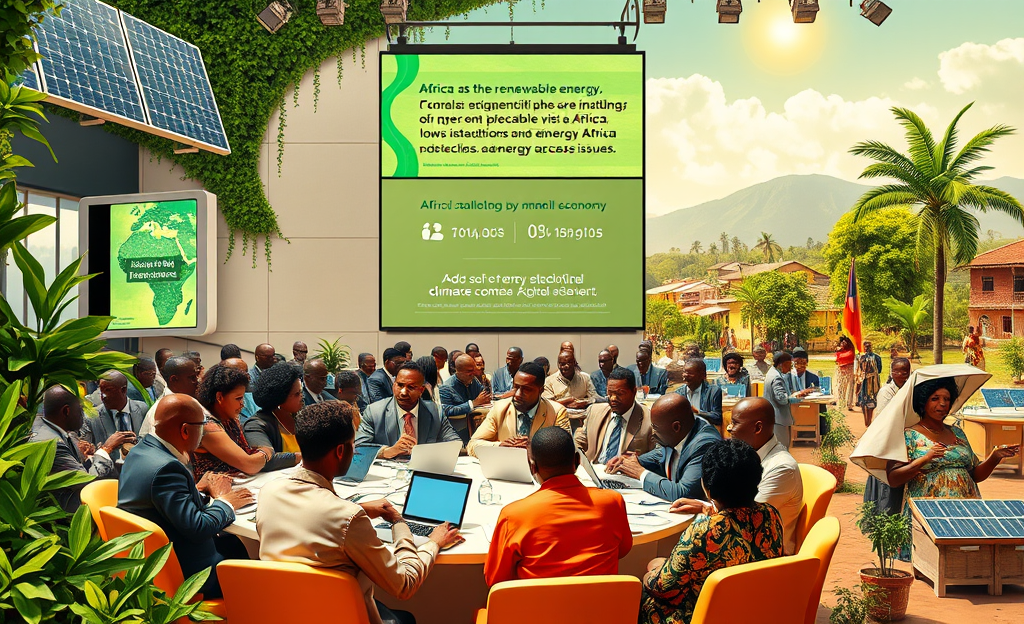
Africa’s Green Economy is witnessing remarkable growth, particularly through the adoption of solar energy.
As leaders convene at the Africa Climate Summit in Addis Ababa, they aim to galvanize support from wealthier nations to tackle climate change challenges.
This article will delve into the urgent need for financing, technology transfer, and capacity building to empower Africa, which, despite contributing only 4% of global greenhouse gas emissions, faces significant hurdles in achieving sustainable development, including low solar panel installations and staggering electricity access issues for millions of Africans.
Solar-Powered Momentum in Africa’s Green Economy
The surge in solar energy adoption is igniting momentum in Africa’s green economy, providing a glimmer of hope for a continent rich in potential.
As leaders converge to request greater support from wealthier nations, they emphasize the pressing need for financing and technology to harness this renewable resource effectively.
Despite accounting for only a small fraction of global emissions, Africa’s efforts to combat climate change hinge on external assistance to ensure sustainable growth and energy access for its people.
Africa Climate Summit: Leaders’ Unified Call in Addis Ababa
Under the vast skies of Addis Ababa, African leaders converge at the Africa Climate Summit, creating a unified front to resonate with the global conscience.
The majestic halls echo with impassioned pleas for more than empty promises; they demand Immediate scaled-up climate finance is non-negotiable.
Amidst the fervor, calls for technology transfer rise, painting a picture of a continent ready to wield cutting-edge tools in the climate struggle.
As conversations flow, the essence of capacity-building becomes undeniable, highlighting the need for skilled hands to mold Africa’s green future.
With urgency, an appeal emerges to the international community to respond decisively and support Africa’s journey.
Import Boom, Installation Lag: The Solar Paradox
The surge in solar panel imports across Africa highlights a promising yet paradoxical trend.
Recent records show that 20 African countries set import records, marking a significant uptick in the continent’s commitment to renewable energy.
Yet, this increase in importation hasn’t smoothly translated into widespread installation on the ground.
Numerous factors, ranging from inadequate infrastructure to financial constraints, impede the rapid deployment of these panels.
According to Cleantechnica, while the availability of solar panels is now more widespread, the path from import to installation requires attention to overcome logistic and monetary bottlenecks.
Relevant text in the context of global energy disparities arises from Africa’s chronic electricity access issue.
Approximately 600 million people without electricity continue to endure energy poverty, underscoring a significant gap despite the import boom.
The challenge lies in bridging this gap effectively, necessitating innovative solutions and enhanced infrastructure.
Moreover, the lack of financing for necessary adaptation measures further complicates this landscape.
Without genuine commitment and practical support from wealthier nations, Africa risks remaining caught in a cycle where high import figures seldom result in tangible energy advancements.
As stakeholders convene to address these issues, the overlapping urgency of equitable electricity access and efficient solar installation remains at the forefront of Africa’s renewable energy aspirations.
The Climate Adaptation Financing Gap
Africa faces a substantial climate adaptation finance deficit, threatening its resilience against climate change.
While the continent requires $70 billion annually to tackle the adverse effects of climate change, the funding received in 2023 fell significantly short, highlighting the urgent need for increased financial support.
This deficit poses severe risks to Africa’s capability to thrive amidst climate changes impacting health, agriculture, and infrastructure.
According to the Adaptation Finance Gap Update 2023, without adequate financial backing, the potential for resilience diminishes considerably, threatening global stability:
| Year | Needed | Received |
|---|---|---|
| 2023 | $70 billion | $15 billion |
Without timely and effective financing, Africa’s adaptation capacity will remain vulnerable, increasing the risk of catastrophic impacts and migration.
Addressing this gap is therefore of utmost importance to ensure resilience and sustainability.
Resource Extraction Dilemmas: Minerals and Gas
Africa finds itself at a crossroads where the demand for critical minerals needed for renewable energy coincides with its economic aspirations and climate responsibilities.
The extraction of these resources, particularly in cobalt and lithium mines, remains a crucial driver of economic activity and energy transition.
However, this ambition is tempered by the region’s ongoing dependence on gas development, even as climate concerns mount.
Wealthy nations have a role in ensuring Africa can pursue these goals sustainably.
- Labor abuses in cobalt and lithium mines
- Environmental degradation from mining activities
- Communities displaced by mineral and gas projects (Inside Climate News on Lithium Mining)
To turn potential pitfalls into progress, Africa needs responsible governance that protects communities and ecosystems while fostering sustainable development.
Why Global Solidarity Matters
Ignoring Africa’s appeal endangers global stability as the continent’s climate challenges are intricately linked to migration and youth development.
With Africa only responsible for a modest 4% of global greenhouse gas emissions, the lack of financial and technological support from wealthy nations could exacerbate migration pressures.
This situation stems from potential climate-induced displacement and increased resource scarcity.
Africa’s youth, in particular, may face limited opportunities due to insufficient infrastructure and economic stagnation.
As leaders gather at the Africa Climate Summit, they emphasize the urgent need to bolster Africa’s green initiatives.
The glaring need for an annual $70 billion in climate finance, against the $15 billion received in 2023, reveals a critical gap.
Therefore, wealthy nations must act decisively to foster Africa’s climate resilience, promoting security and ensuring inclusive growth worldwide, thereby averting the dire consequences of inaction.
In conclusion, addressing Africa’s Green Economy needs is not only vital for the continent’s future but also critical for global sustainability.
By supporting Africa’s efforts, wealthier nations can help mitigate broader consequences, such as migration and youth development challenges.



0 Comments