China Boosts Humanoid Robot Training Efforts
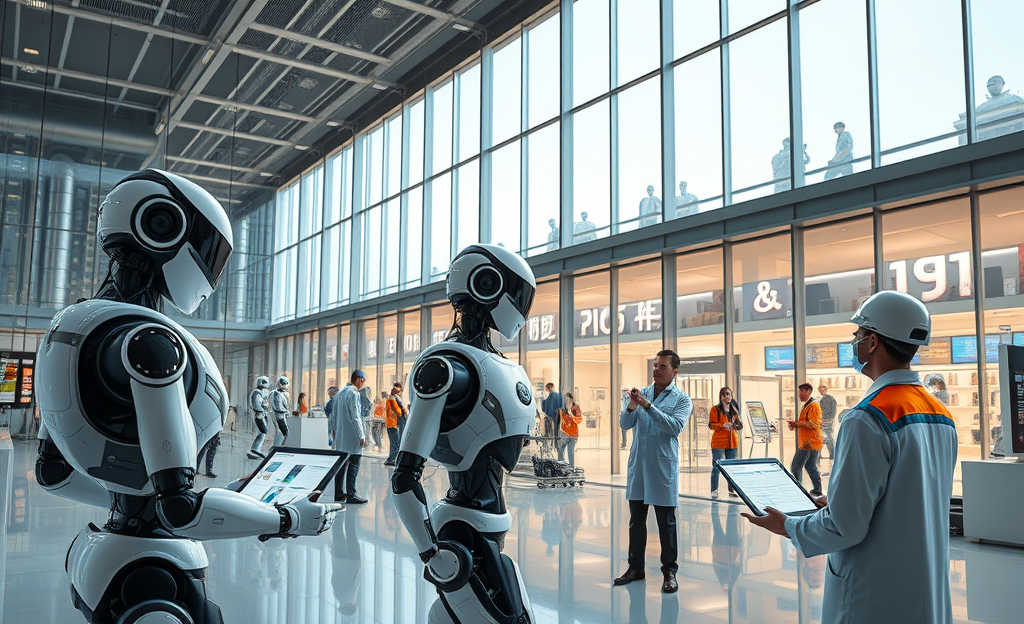
Robot Training is becoming a focal point in China’s ambition to lead the global market in advanced humanoid robotics.
This article delves into China’s significant investments in developing extensive training facilities, particularly in the Shijingshan district of Beijing, and examines how these efforts aim to alleviate challenges such as data scarcity in the domestic robotics industry.
As robots are trained across 16 critical scenarios, we will explore how standardized and large-scale data collection can enhance quality and reduce costs, positioning China at the forefront of technological innovation in robotics.
China’s Strategic Race in Humanoid Robotics
In the rapidly evolving realm of humanoid robotics, China is mounting significant efforts to overtake the United States and establish itself as a leader in this cutting-edge domain.
The strategic development is exemplified by the establishment of expansive training bases, like the one in Beijing’s Shijingshan district, which spans over 10,000 square meters, aiming to address the issue of ‘data scarcity.’ By generating over 6 million data points annually, these facilities provide a robust foundation for training robots across 16 specific scenarios such as factories, elderly care centers, and smart homes.
This ambitious undertaking not only enhances China’s capabilities in robotics but also signifies its broader industrial vision, supporting the development of new technology sectors.
As China surges forward with standardized and large-scale data collection, it aims to gain a strategic advantage that could reshape the global dynamics in advanced industries, a point highlighted in resources like VoA’s report on China’s advancements.
The Shijingshan Flagship Training Base
The Shijingshan Flagship Training Base is an unprecedented facility that exemplifies China’s ambitious strides in humanoid robot development.
Located in the bustling Shijingshan district of Beijing, this remarkable complex spans over 10,000 square meters, making it the largest of its kind in the nation.
The base will play a crucial role in advancing robotics technology by generating over 6 million data points annually, aimed at enhancing the quality of training data for various applications.
Infrastructure and Spatial Design
- Main testing hall
- Simulation arenas
- Data-processing suites
The facility strategically distributes its floor space across these core zones to enhance functionality and efficiency.
The Main testing hall serves as the primary area where large-scale robot trials occur, allowing for comprehensive analyses of robotic capabilities in real-world scenarios.
Adjacent to the testing hall, the Simulation arenas tailor environments to mimic specific conditions, bridging the gap between isolated testing and actual application.
Meanwhile, in the heart of the facility, Data-processing suites manage the vast volumes of data generated, ensuring high-quality output feeds the robots’ learning algorithms, advancing China’s competitive edge in robotics.
High-Volume Data Generation
The state-of-the-art facility in Beijing’s Shijingshan district emphasizes a 6 million annual data point generation capability, showcasing its robust sensor arrays and cloud-edge architecture.
These technologies enable seamless data collection, labeling, and storage processes.
Sensor arrays gather comprehensive interaction records across various scenarios, ensuring meticulous data accuracy.
This information is transferred through an intricate cloud-edge network, enabling swift and efficient data processing.
The continuous data pipeline enhances predictive analytics, refining the models that power humanoid robots.
Partnering with reliable platforms, such as the “Largest Humanoid Robot Training,” further ensures the facility stays at the forefront of the robotics industry.
Advances in this data infrastructure position China to surpass global competitors in humanoid robotics development.
Conquering Data Scarcity in China’s Robotics Eco-System
The development of advanced humanoid robots in China is significantly hampered by a lack of high-quality, scenario-rich data, which is essential for training these machines effectively.
Without access to diverse and comprehensive data sets, domestic robotics firms struggle to create robots that can perform in real-world environments.
In response to this challenge, China is establishing large training bases aimed at overcoming data scarcity by generating standardized and rich data collections across various scenarios.
Standardization and Cost Reduction
Standardized data collection is a cornerstone in advancing domestic robotics, especially through large training bases like those in Beijing’s Shijingshan district.
These facilities generate over 6 million data points annually, effectively addressing the ‘data scarcity’ problem that impedes industry growth.
By utilizing AI Embodied Agent Standards to establish unified frameworks, companies can enhance both scalability and efficiency.
This approach substantially reduces training expenses.
Implementing standardized modules significantly shortens development cycles, enabling rapid iteration.
Furthermore, the relevantly improved data quality facilitates better decision-making, ultimately lowering costs by eliminating redundant resources and processes.
Immersive Training Across 16 Real-World Scenarios
In the bustling realm of robotics, training these humanoid creations across 16 specific scenarios is paramount for advancing their dexterity, perception, and autonomy.
As China makes strides with its vast training bases, robots now navigate through varied environments such as factories, retail stores, elderly care centers, and smart homes.
Each of these domains requires a distinct approach to data collection and processing to create truly versatile robots.
In the factory setting, robots perform precision assembly tasks showcasing their ability to handle intricate components efficiently.
Meanwhile, in retail settings, they assist customers and manage inventory, adapting to dynamic interactions.
In elderly care, they provide essential support for daily activities, monitoring health and ensuring safety.
Within smart homes, robots seamlessly integrate into daily routines, learning to manage household chores autonomously.
This diverse training landscape helps create more intelligent, adaptive, and versatile robots.
| Scenario | Training Task |
|---|---|
| Factory | Precision assembly tasks |
| Retail | Inventory management |
| Elderly Care | Health monitoring |
| Smart Home | Household chore automation |
In conclusion, China’s strategic focus on robot training and data collection not only addresses existing industry limitations but also sets the stage for a new era of advanced humanoid robotics, potentially reshaping the landscape of global technology.



0 Comments