Nintendo Entertainment System Revolutionized Gaming
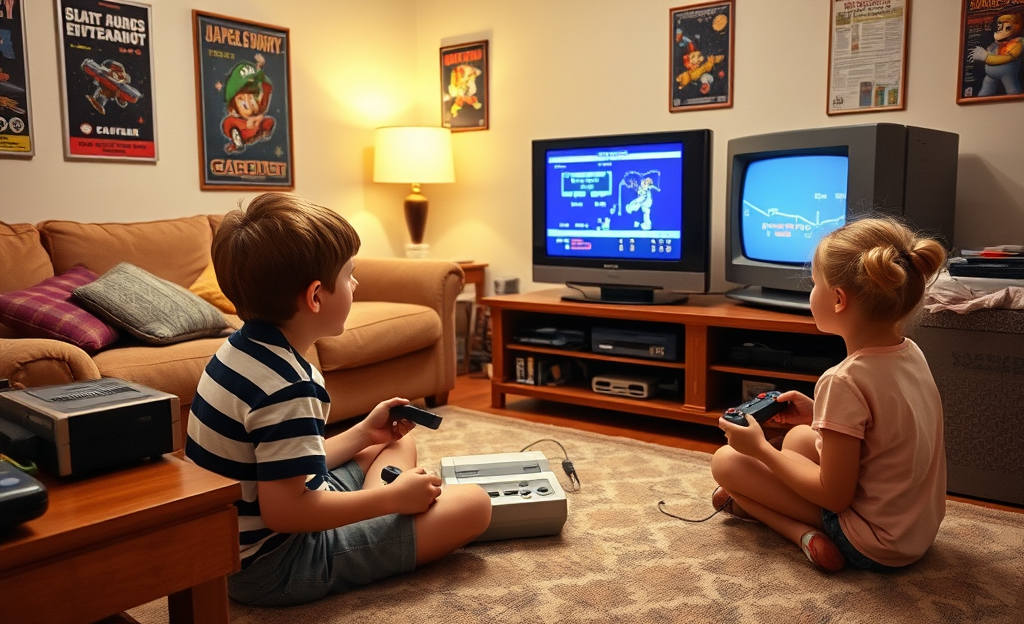
Video games have transformed entertainment, and few consoles have left as lasting a legacy as the Nintendo Entertainment System (NES).
Launched in the United States on October 18, 1985, the NES became a defining force in the gaming industry, eclipsing competitors like Atari.
This article delves into the NES’s remarkable journey, exploring its innovative titles, the unforgettable characters it introduced, and its role in shaping a generation’s shared experiences.
From the adventurous realms of Super Mario Bros to the engaging simplicity of Duck Hunt, we’ll uncover how the NES not only entertained but also united families and friends across America.
The Birth of the Nintendo Entertainment System in the US
Amidst the shimmering lights of 1985 New York City, a quiet revolution began.
On October 18, 1985, the Nintendo Entertainment System (NES) hit select store shelves, marking a pivotal moment in gaming history.
This low-profile release ignited imaginations and set the stage for a gaming renaissance.
Eager children and curious adults alike flocked to experience something truly unique, as the Wired detailed earlier.
Excitement buzzed through crowds as they lined up for this innovative console bundled with Super Mario Bros, a game heralding a new era of immersive experiences.
In those early days, the NES introduced a primary language of pixels and possibilities to American households, creating an indelible effect on both players and the market.
Its influence is evident, as the NES rapidly became synonymous with gaming, surpassing contemporaries such as Atari.
- The launch was limited to a few stores but created an enormous buzz.
- Super Mario Bros captivated and defined what games could become.
- Nintendo hosted trials for hands-on experiences, ensuring interest.
- Retail bundles enticed buyers with a complete entertainment setup.
This marked the beginning of a gaming giant’s rise, changing the landscape forever.
NES vs Atari: Revolutionizing the Gaming Industry
The Nintendo Entertainment System (NES) dominated the gaming scene in the 1980s by leveraging advanced technology and design compared to the Atari systems.
With its superior graphics capabilities, the NES provided a much more vibrant and immersive experience, making games like Super Mario Bros a household name.
According to a comparison in Retro vGames, the NES’s capabilities made other consoles pale in contrast.
The smaller, more dependable game cartridges allowed for more sophisticated games, and thus, set the NES apart as a benchmark for quality.
This bold milestone not only revived interest in video games after the crash of 1983, but also defined gaming standards going forward.
Meanwhile, while Atari paved an early path in the gaming industry and laid the groundwork during the 70s, its star began to fade as the NES arrived with fresh, enticing features.
With a focus on character-driven narratives and intricate gameplay, NES stood out in providing players with deeper engagement.
Additionally, the inclusion of iconic characters like Mario and Zelda reinforced its appeal, making it synonymous with gaming culture.
As noted by DesktopGaming, the NES’s underlined emphasis on game variety and depth created a new era of gaming that reshaped consumer expectations and firmly established Nintendo as a leader in the entertainment industry.
Immersive Gameplay: Super Mario Bros and Duck Hunt
Super Mario Bros on the NES captivated players with its dynamic platforming adventures.
Mario, the fearless hero, traverses the Mushroom Kingdom to rescue Princess Toadstool.
The vibrant and colorful worlds in the game are filled with inventive enemies and challenging obstacles, making every level an exhilarating experience.
Transitioning from simple Goomba stomps to epic showdowns with Bowser showcases the game’s ability to scale intensity and keep players engaged.
Every warp pipe and hidden power-up adds surprise elements, encouraging exploration and discovery.
- World-1 warp pipe
- Hidden 1-Up mushroom
Duck Hunt provides an equally immersive experience with its intuitive use of the NES Zapper Light Gun.
Unlike the platforming antics of Super Mario Bros, Duck Hunt lures players into the exciting world of virtual hunting.
The game’s sound effects, from the fluttering ducks to the triumphant bark of the hunting dog, immerse players even further.
Each round intensifies as ducks fly faster and more erratically, challenging even the most skilled marksmen.
- Secret bonus round
- Trick shots on both ducks
Together, these elements form the unforgettable essence of the NES era, igniting the imaginations of a generation.
Mario: The Iconic Character and NES’s Cultural Impact
Back in the 1980s, on school playgrounds across America, Mario wasn’t just a character on a screen, but a beloved phenomenon bridging generations.
Children gathered under monkey bars, exchanging tips and secrets unearthed in Super Mario Bros.
, where each conquered level felt like a community victory.
Jumping across goombas and saving Princess Peach evolved into a shared language, creating friendships bonded by their quests in the Mushroom Kingdom.
Even parents couldn’t escape discussing Mario’s adventures, as he provided a much-needed breath of entertainment and camaraderie.
Through games like Duck Hunt, families found a reason to gather around the NES together.
Mario leapt beyond the screen, becoming a fixture in Halloween costumes, lunchtime chatter, and even classroom doodles, weaving a colorful thread through the tapestry of childhood memories of an entire generation.
Entertainment for the Whole Family: The NES Effect
The Nintendo Entertainment System (NES) emerged in the 1980s as a cornerstone for family entertainment, sparking multigenerational bonding that few other devices could replicate.
Households would gather around the flicker of their television screens, captivated by the adventures of Mario and his creative world, as well as games like Duck Hunt, which had everyone cheering and sharing tips over the shared experience.
This delightful ensemble of gaming not only entertained kids but also allowed parents to enjoy some moments of peace, free from worries.
The NES became a symbol of togetherness and connection in many living rooms.
| Benefit | Who Enjoys It |
|---|---|
| Shared laughter | Everyone |
| Problem-solving skills | Kids |
| Relaxation time | Parents |
| Cooperation and teamwork | Everyone |
In conclusion, the NES was more than a console; it was a cultural phenomenon.
Its impact on video gaming and family entertainment continues to resonate, proving that the magic of the NES remains alive in the hearts of many.



0 Comments