Sanctions Spark Reactions From Moscow Amid Tensions
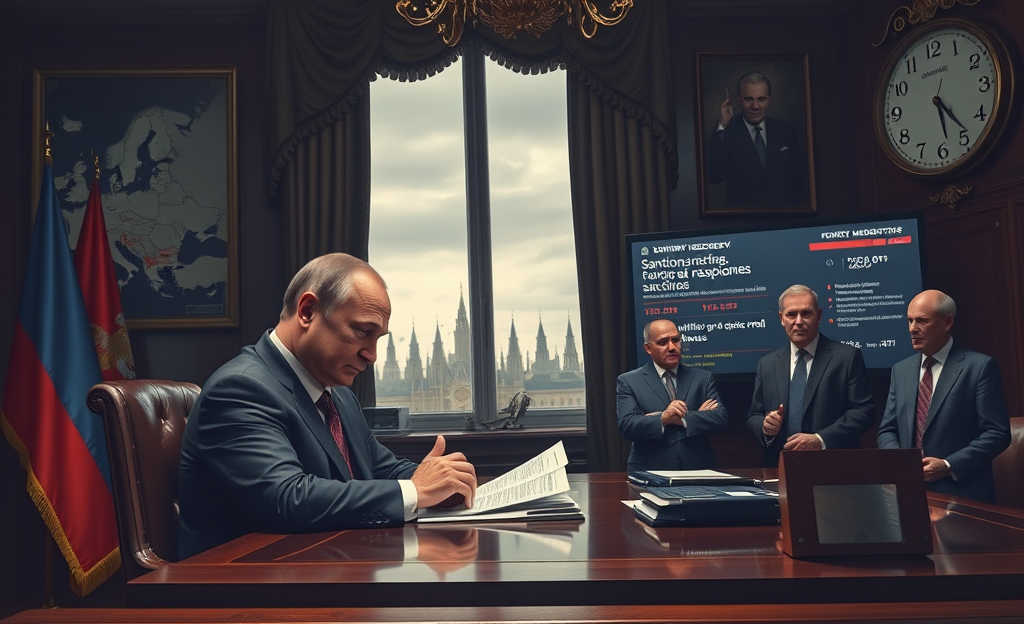
Russian oil has become a focal point of international tensions as the U.S. imposes a new series of sanctions on major companies like Rosneft and Lukoil.
This article delves into the ramifications of these sanctions, highlighting reactions from Russian leaders, and the potential implications for global energy markets.
With President Putin branding the measures as a ‘hostile act’ and former President Medvedev suggesting a looming conflict, we explore the broader geopolitical landscape.
Additionally, Ukrainian leaders’ hopeful reception reveals contrasting perspectives, setting the stage for an examination of Russia’s adaptive economic strategies amid ongoing sanctions.
Overview of U.S. Sanctions on Rosneft and Lukoil
Washington has taken a decisive step by targeting two of Russia’s major energy companies, Rosneft and Lukoil, with imposed sanctions as part of broader efforts to exert economic pressure.
These measures are expected to disrupt the international operations of both companies, significantly affecting their ability to conduct transactions in dollars and access global financial networks.
These restrictions aim to curtail funding for what the U.S. describes as the Kremlin’s ongoing military endeavors.
The Russian government has perceived this move as a Relevant text aggressive tactic, causing a significant ripple in international diplomacy.
The backlash in Moscow was immediate, highlighting the tension between the nations.
- President Vladimir Putin denounced the sanctions as a hostile act, warning of potential global repercussions
- Russian media characterized the move as a path towards escalated confrontation
- The sanctions initially stirred positive reactions among Ukrainian leaders
Moscow’s Official Reactions
Moscow’s leadership has responded robustly to the recent sanctions imposed by the U.S. against its oil companies.
President Vladimir Putin has characterized the sanctions as a ‘hostile act’ that would not fundamentally undermine the Russian economy, while warning of potential repercussions for global gas prices.
Former President Dmitry Medvedev has asserted that the U.S. is pursuing a path of war with Russia, indicating a unified stance among top officials in the face of external pressures.
Putin Calls the Measures a Hostile Act
President Vladimir Putin has described the recent U.S. sanctions on Russian oil companies, Lukoil and Rosneft, as a hostile act.
He emphasized that these economic measures would not significantly damage Russia’s financial stability but warned of their potential repercussions.
Putin specifically highlighted the risk of global gas price increases, suggesting that such actions could have far-reaching implications beyond politics.
“These restrictions are a hostile act that does not strengthen relations and may lead to an increase in global gas prices,”
he asserted, pointing to the interconnected nature of international energy markets.
Medvedev Warns the U.S. Is on a Path to War
Dmitry Medvedev, Russia’s former president, made a startling declaration, claiming that the U.S. has embarked on a path of war with Russia.
His words underscore a significant increase in aggressive rhetoric following recent U.S. sanctions on Russian oil companies Rosneft and Lukoil.
Medvedev, expressing his disdain on social media, stated,
“The United States is our adversary, and their talkative ‘peacemaker’ has now fully embarked on the warpath with Russia.
“
This assertion highlights the intensifying geopolitical tensions and the potential ramifications for global diplomacy and economic stability.
International Support and Security Responses
The recent sanctions imposed by the U.S. against Russian oil companies have triggered a wave of international reactions and security measures.
Foreign governments and security alliances, particularly NATO, have stepped up their responses, reflecting a unified stance against perceived aggressions.
As incidents such as the violation of Lithuanian airspace occur, the dynamics of international support and security responses are critically examined.
Ukrainian Leaders Applaud the Sanctions
Ukrainian leaders have expressed enthusiastic approval for the recent U.S. sanctions against Russian oil companies.
These measures are seen as a powerful tool to exert pressure on Russia amid their ongoing conflict.
Ukrainian President Volodymyr Zelenskyy described the sanctions as a significant step towards holding Russia accountable for its actions.
The Ukrainian World Congress also welcomed the decision, viewing it as a meaningful stride toward justice.
“We welcome these measures as they demonstrate the global community’s commitment to our cause,”
stated a Ukrainian official.
The sanctions reinforce international support for Ukraine, strengthening its position on the global stage.
NATO Answers Lithuanian Airspace Violation
Two Russian military aircraft briefly violated Lithuanian airspace, highlighting ongoing regional tensions.
Lithuania reported that the aircraft, including an SU-30 fighter, entered for about 18 seconds, which prompted a NATO military response.
According to Lithuania’s military, the Russian planes ventured 700 meters into their sovereign territory, sparking immediate concern.
NATO quickly reacted by scrambling fighter jets in response to this provocation.
NATO scrambled jets to ensure the integrity of allied airspace, reflecting the alliance’s commitment to defense.
Such incidents stress the importance of maintaining NATO’s readiness in face of regional challenges and underscore Lithuania’s strategic relevance.
Economic Adaptation and Challenges Ahead
Russia has adeptly cushioned the blow of earlier sanctions by significantly bolstering energy trade with China and India.
As European partners stepped back due to U.S. and EU economic restrictions, Moscow shifted its focus eastward, facilitating an expanded trade network with these major Asian economies.
This strategic pivot has enabled Russia to maintain a steady flow of revenue despite mounting global pressures and sanctions enforcement challenges.
| Channel | Before | After |
|---|---|---|
| Oil sales to India | Rising | Under Review |
| Oil sales to China | Stable | Potential Growth |
| Trade sanctions adjustment | Resilience Building | Ongoing Adaptation |
- Ensuring consistent sanctions enforcement across borders remains challenging.
- Addressing the complexities of nations still purchasing Russian oil is essential.
- Maintaining pressure on third-country enablers requires detailed and consistent oversight.
Russian oil sanctions mark a crucial moment in U.S.-Russia relations, with significant implications for global energy dynamics.
As the situation evolves, the effectiveness of these sanctions will depend on sustained enforcement and the global community’s cooperation.



0 Comments