Economic Performance Perception Under Scrutiny
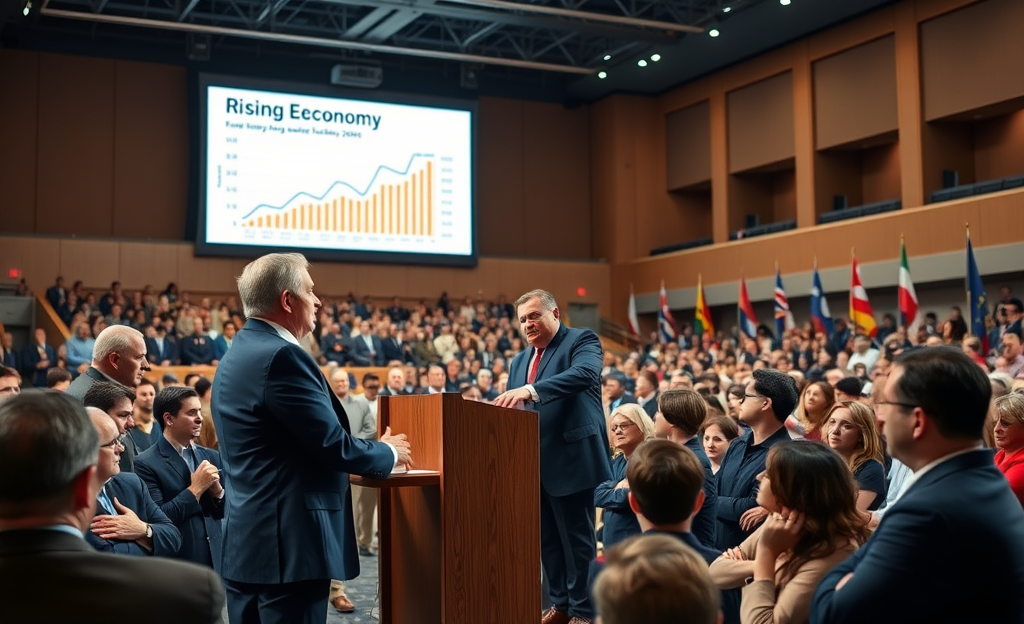
Economic Performance is a hot topic as the administration faces scrutiny over its handling of the economy.
With inflation remaining above pre-pandemic levels and unemployment hitting 4.6%, the narrative crafted by the administration defends its record while attributing negative aspects to previous leadership.
This article will delve into the complexities of these claims, the growing concerns among voters regarding rising prices, and the implications for the upcoming 2026 midterm elections as discontent mounts and approval ratings fall.
Defense of Economic Performance Amid Challenges
On December 17, 2025, the administration took a firm stance in defending the economic performance of the country.
They argued that despite facing challenges such as elevated inflation and a 4.6% unemployment rate, the overall state of the economy is more robust than the public perception suggests.
This defense comes at a critical time as voter discontent grows and approval ratings decline, highlighting the urgency of reshaping the narrative ahead of the 2026 midterm elections.
Attribution of Economic Challenges to the Predecessor
Political leaders often find themselves shifting the burden of economic challenges to their predecessors, a tactic seen vividly in the latest national discourse.
The inflation levels above pre-pandemic rates, coupled with an unemployment rate standing at 4.6%, are described as remnants of the previous administration’s decisions.
This rhetoric closely mirrors the pre-2024 campaign strategies, where responsibility for economic turbulence was continuously linked to former leadership.
President Donald Trump, for example, has been known to highlight these issues, constructing a familiar narrative where current hardships are depicted as inherited obstacles, as pointed out in a recent CNN analysis on Trump’s strategy.
Through this approach, the current administration seems to aim at deflecting voter frustration over rising prices and unemployment, issues that remain at the forefront of public concern.
Positive Economic Indicators Amid Discontent
The administration’s economic narrative emphasizes robust job creation, steady wage growth, and a resilient GDP, which suggest a thriving economy.
However, mounting voter frustration persists, largely due to promises to curb inflation that remain unfulfilled, impacting perceptions at grassroots levels.
The contrast becomes evident when acknowledging that, despite the economic indicators’ positivity, the psychological weight of rising costs can’t be ignored.
Increasing prices continue to affect America’s households significantly, leading to a disconnect between reported data and lived experiences.
This dissonance contributes to discontent reflected in a recent poll showing approval ratings at just 36%, indicating deep-seated economic concerns, such as those discussed in Politico’s analysis.
Transitioning from economic theory to tangible relief remains crucial.
Analysts’ Warnings on Voter Reception
Political analysts have voiced concern that the administration’s attempts to highlight economic performance are overshadowed by voter anxiety about rising costs, such as groceries and housing.
Despite efforts to frame the economic narrative positively, disconnection between messaging and public perception remains stark.
Rising prices, as detailed in Advisor Perspectives, contribute significantly to electoral unease with 56% of Americans seeing cost of living as the top issue.
Analyzer’s Attention converges on the gap between political rhetoric and daily realities facing families, challenging the administration’s narrative.
- Inflation outpaces wage growth
- Cost of necessities remains high
- Unmet expectations for economic relief
Balancing this perception proves critical as emphasized in a New York Times Political Analysis.
The disillusionment extends to party lines, showing a significant drop in approval ratings to 36%.
Voter trust in economic promises wanes as election campaigns approach, posing challenges for repositioning economic messaging.
Narrative Shift Ahead of the 2026 Midterms
As the 2026 midterm elections approach, recent speeches by the administration aim to shift the narrative surrounding economic performance, seeking to reshape public discourse amidst rising inflation and unemployment concerns.
By highlighting positive economic indicators while attributing negative perceptions to a predecessor, the administration hopes to bolster its political capital and appeal to voters dissatisfied with current conditions.
However, with approval ratings faltering due to economic pressures, this strategy faces significant challenges in resonating with an increasingly discontent electorate.
Plummeting Approval Ratings and Growing Discontent
The administration faces significant challenges as the approval rating has plummeted to 36% approval, according to a new poll from NPR.
This decline is largely attributed to persistent economic issues that have not gone unnoticed by voters.
Rising inflation remains a pressing concern, with many Americans expressing dissatisfaction over the administration’s inability to deliver on its promised economic relief measures.
Furthermore, rhetoric asserting a rebounding economy fails to resonate as voters prioritize the reality of escalating living costs.
The narrative also highlights growing discontent within the administration’s party, as expectations for substantial policy outcomes remain unmet.
Addressing these financial ambiguities will be crucial in altering public perception.
In summary, the administration’s defense of its economic performance faces significant challenges amid rising inflation and voter discontent.
As the 2026 midterm elections approach, how effectively they address these issues may very well determine their political future.



0 Comments