Trump’s Trade Tariffs and Economic Emergency
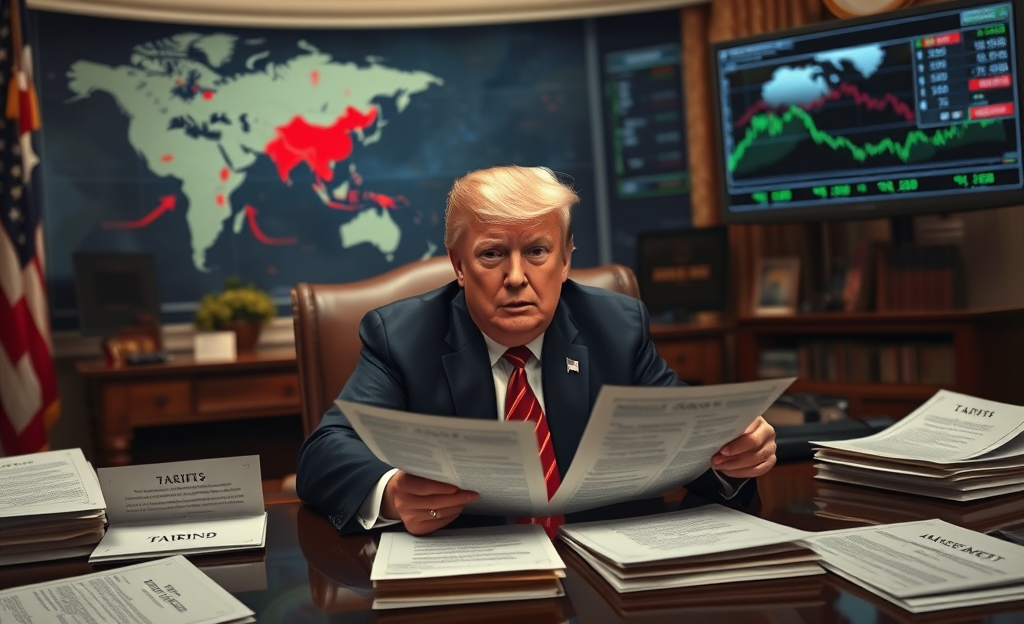
Trade Tariffs have become a contentious tool of economic policy in the United States, particularly during the early days of Donald Trump’s second term.
In a move that many criticized, Trump declared an ‘economic emergency’ and announced tariffs with little justification, leading to significant turmoil in global markets.
This article will explore the implications of these decisions, including the confusion they caused in international trade and how they reflected a broader trend of presidential overreach in economic policy.
We will also examine the reactions from Congress and the attempts to negotiate new trade agreements amidst this chaotic environment.
Trump’s Declaration of an Economic Emergency
During the early days of his second term, Donald Trump declared an economic emergency, allowing him to impose tariffs unilaterally and effectively sideline Congress.
Through this declaration, Trump capitalized on the International Emergency Economic Powers Act to argue that foreign trade practices severely threatened U.S. economic security.
With this move, he aimed to fortify America’s competitive edge, acting without the usual congressional oversight that traditionally governs the imposition of tariffs.
His approach enabled a series of tariffs without alignment with legislative procedures, creating a significant shift in trade policy.
The political and legal implications of this strategy were profound and contentious.
By sidelining Congress, Trump not only set a precedent for unilateral decision-making but also stirred debates about the limits of executive power in economic policy .
Critics argued that using emergency powers to enforce tariffs constituted a misuse of presidential authority, raising concerns over potential abuses of the IEEPA.
The uncertainty surrounding these actions contributed to global trade disruptions, with major trading partners voicing frustration over the unpredictability of U.S. tariffs.
Ultimately, this approach exemplified an administration willing to push legal boundaries to achieve its trade objectives.
Liberation Day and Its Immediate Aftermath
On April 2, 2025, President Donald Trump declared the day as ‘Liberation Day’ and unveiled a series of controversial tariffs that sparked immediate backlash.
These tariffs, criticized for their lack of solid foundations, led to swift turbulence in both domestic and global markets.
As confusion reigned over trade policies dictated by an unconventional approach, the ramifications of this day would resonate far beyond its immediate effects.
Global Market Turbulence and Temporary Pause
The onset of volatility in world markets was immediate when President Trump announced a series of tariffs on April 2, 2025, branding it as ‘Liberation Day.’ Financial markets globally spiraled into chaos as investors reacted to Trump’s unilateral decision, sending stock indices plunging and unsettling currency exchanges.
Concerns regarding supply chain disruptions and trade partnerships further intensified the market’s nervous response.
Companies across multiple sectors saw significant fluctuations in their valuations, reflecting doubts about the international trade stability and the overarching global economic environment.
Despite the turmoil, Trump temporarily paused the tariffs just a week after their announcement in an effort to pursue alternative trade agreements.
However, as noted in the analysis by Yale SOM, this pause failed to quell investor concerns as no new deals were solidified.
The erratic nature of policy-making undermined efforts to rebuild trust with global trading partners.
Ultimately, as no successful negotiations emerged, the pause proved futile, with the world markets left bracing for further uncertainty.
July 8 Tariff Threats Against Asia
On July 8, President Trump’s administration reignited tensions by renewing tariff threats targeting Japan and South Korea, directly influencing global trade relations.
In a week filled with uncertainty and market volatility, Trump announced a new wave of unilateral tariffs threatening to impose a 25% levy on the goods of these Asian allies if trade agreements weren’t reached by the August 1 deadline.
This unresolved situation escalated fears of a prolonged economic standoff, leaving both nations scrambling to negotiate and avoid the punitive measures.
The lack of transparency and Trump’s unpredictable approach further fueled anxiety.
According to CBS News, the global markets remained on edge, with stakeholders uncertain of the administration’s next move.
As the deadline loomed, the stark pressure was evident, emphasizing the fragility and volatility ingrained in international trade under Trump’s policy direction.
Impact on U.S. Trade Policy and Congress
President Trump’s unilateral tariff actions illustrate an unsettling shift in U.S. trade policy, where presidential prerogatives overshadowed legislative oversight.
By declaring an ‘economic emergency’, Trump bypassed Congress, a move that not only undermined the constitutional balance of power but also intensified confusion within the trade arena.
This approach, as discussed in Implications of Tariff Enforcement highlight how stakeholders struggled to adapt to the shifting policies, reflective of a leadership with limited understanding of tariff mechanics.
Trump’s tariffs imposed shocks not just on global markets, but also on domestic economies
, inducing a period of heightened uncertainty.
This methodology, anchored in a narrow perspective of national interest, challenged traditional diplomatic and trade relations, creating a rift with allied nations such as Japan and South Korea.
As tariffs were announced and rescinded with increasing frequency, the U.S. faced backlash and retaliatory measures, further complicating already delicate trade negotiations.
This approach fundamentally altered U.S. trade policy, where decisions were impulsive, and the absence of a coherent strategic plan made adaptation and forecasting highly challenging.
Instead of collaborative, informed decisions, it left a void filled by unease and hesitance across international partners.
- Congress sidelined
- Erratic tariff implementation
- Heightened global uncertainty
Trade Tariffs initiated by Trump not only created confusion but also highlighted the risks of unilateral economic measures.
The sidelining of Congress and the erratic nature of these policies underscore the challenges of navigating international trade in a politically charged atmosphere.



0 Comments